A round face shape is about the relationship between length, width, and curves, not about having full cheeks or looking younger than your age. It commonly appears almost as wide as it is long, with the cheek area providing the broadest point and a jawline that turns gently into a rounded chin. Those proportions can be striking, delicate, sporty, or glamorous. Naming them is only useful when it helps you decide what you want a haircut, pair of glasses, or makeup placement to do.
Look for the overall outline before measuring details
Begin with a photo taken straight on, in even daylight, with your hair away from the sides of your face. A round face usually has a soft, circular impression from forehead to jaw. The face length is close to the width across the cheeks, though it does not need to be mathematically identical. The sides tend to curve outward at the cheeks and taper smoothly toward the chin rather than running in straight vertical lines.
Compare the cheeks, jawline, forehead, and chin
Do not decide from a close selfie. A wide phone lens makes the central part of the face look broader, which can turn an oval face into a round-looking one in seconds. Stand a few feet back, use the standard lens, and compare at least two photos. The pattern that stays put when the angle changes is more useful than a single image you happen to like.
Round face characteristics are usually clearest around the mid-face. Cheek width is noticeable, and the transition from cheek to jaw is curved rather than sharply angled. The jaw may still be defined; round does not mean undefined. What matters is that the jaw corners do not look like the widest, most architectural part of the face. The chin is commonly short to medium in visual length and rounded, but it may also be subtly pointed.
The forehead often has a similar curved quality, with temples that do not project strongly beyond the cheeks. A broad forehead does not rule out a round face, and neither does a high hairline. Hairline shape is highly individual. Compare the three horizontal zones instead: forehead, cheekbones, and jaw. When the cheeks lead and both the top and bottom soften inward, the round category becomes more plausible.
| Feature | Common round-face reading | Useful reality check |
|---|---|---|
| Length and width | Close in visual proportion | Check a non-wide-angle photo |
| Cheeks | Broadest or most prominent area | Look with hair pulled back |
| Jawline | Curved, without strong corners | Ignore shadow from one side |
| Chin | Soft, rounded, or gently tapered | Do not judge from a downward head tilt |
Tell a round face from oval and square
Oval and round faces can both have smooth cheeks and soft jaws. The difference is usually vertical space. An oval face has more visible length from hairline to chin and often narrows more gradually at both ends. A round face reads compact through the center; its width is not just a feature but part of the overall first impression.
Square faces may have a similar width at forehead, cheeks, and jaw, but their outline has stronger corners at the temples or jaw. On a round face, those transitions are usually less abrupt. If your face is broad at the cheeks yet the jaw is quite angular, you may sit between categories. That is normal. Instead of forcing a verdict, notice which styling ideas give you the result you prefer: extra height, more width, softer edges, or cleaner structure.
Pick haircut silhouettes before copying a specific cut
The familiar advice for a round face is to add length, and it can be helpful when you want a more elongated look. A side part, height at the crown, or layers that begin below the cheekbones can shift the eye vertically. Long face-framing pieces are especially practical because they can be adjusted day to day. They are not a commandment, though. A rounded bob can look excellent if the goal is to emphasize the face’s softness rather than conceal it.
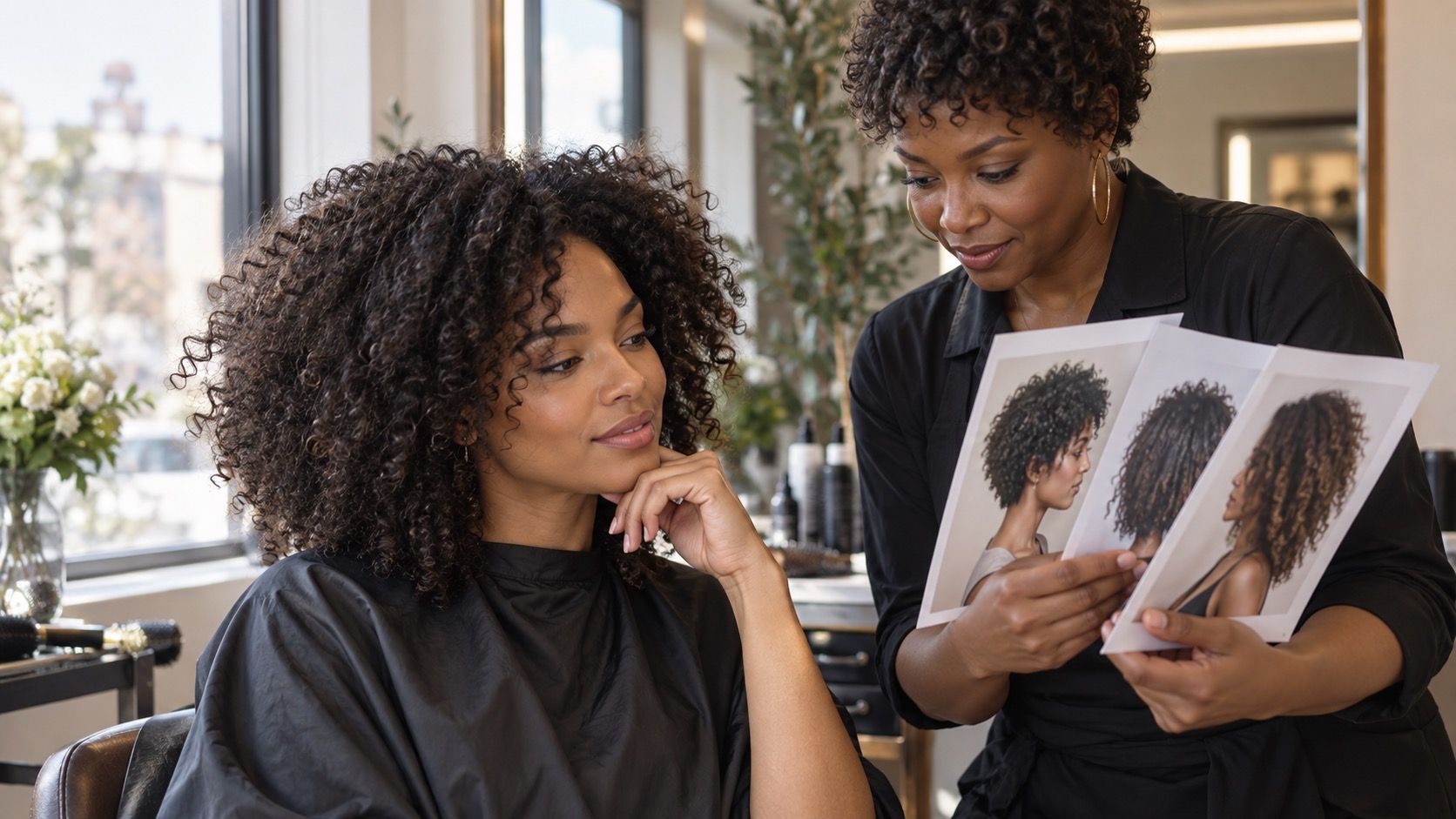
Pay attention to the widest point of the haircut. Heavy volume ending exactly at the cheeks may make the mid-face look broader; volume above the crown or below the chin tends to change the balance differently. With curly hair, the natural shape of the curl matters more than a diagram. Ask a stylist where the haircut will expand once it dries, and look at references with hair density close to yours. A polished photo of straight, heat-styled hair is a poor prediction for a dense curl pattern.
Fringe can be chosen by forehead and maintenance preferences, not by a ban on “shortening” the face. Curtain bangs parted away from the center create an open vertical line. A wispy side-swept fringe introduces movement. A blunt full fringe creates a stronger horizontal statement and may be exactly right if you want a graphic, compact effect.
Choose frames by scale and contrast
Angular glasses are often suggested for round faces because their straight lines create contrast with soft curves. Rectangular, gently upswept, and geometric frames can all do that, but frame size is more important than the label. A narrow frame can make a broad cheek area seem wider by comparison. One that sits roughly in line with the temples usually feels more balanced.
There is no reason to avoid round frames if you enjoy them. Their effect is softer and more cohesive, especially in a thin metal style. Try both directions in natural light. Notice whether the frame rests high enough on the bridge, whether its bottom edge touches the cheeks when you smile, and whether your brows remain visible in a way you like. Comfort will outlast a fashionable face-shape rule.
Use makeup placement to test an effect, not fix a face
Makeup can add a little vertical movement when that is the look you want. Blush swept from the apple of the cheek toward the temple creates a lifted line; keeping the color slightly above the lowest cheek area can prevent it from pulling downward. A soft bronzer at the temples and below the cheekbone can provide dimension, but a hard stripe usually looks detached in daylight.
For brows, a gentle rise or a slightly extended tail can introduce direction without changing your natural expression. A very high, sharp arch may work for a dramatic look but can feel unlike you in an everyday mirror. Change one element at a time and take photos from the same distance. That small experiment tells you far more than a list of rules about what a round face should do.
Keep the useful part of the label
How to know if you have a round face comes down to repeatable clues: face length and width are close, the cheeks carry visual width, and the jawline and chin read as soft curves. Facial fullness can amplify that effect, but it is not the definition. Lighting, a beard, and a new haircut may change the way the face reads without changing its basic structure.
Use the label to generate options, then make the final call in a mirror and a photo. If you like a haircut that looks wider, choose it. If a sharp frame feels too severe, leave it on the shelf. A face-shape category should make decisions easier, not turn personal taste into a mistake.