Getting a different face-shape result from a mirror, photo, and online guide is normal. Faces are three-dimensional, slightly asymmetrical, and affected by hair, expression, lenses, and lighting. The aim is not to force a perfect category; it is to notice stable proportions well enough to make useful choices about hair, glasses, makeup, or grooming. Most face shape mistakes come from treating one temporary image as final evidence.
Do not let one feature choose the whole category
A strong jawline can make someone assume they have a square face, even when their cheekbones are the widest point and their face is noticeably longer than it is wide. A pointed chin can suggest heart shape, yet a person may have a narrow forehead and broad cheekbones that read more like diamond. This is single-feature bias: one memorable detail takes over the analysis.
Measure from landmarks, not from hair or shadow
Look at the outline in four zones instead. Compare the forehead near the temples, the outer cheekbones, the jaw corners, and the length from hairline to chin. Then look at how these areas relate. A square face is not merely a face with a defined jaw; it usually has similar forehead and jaw width. A round face is not just a face with full cheeks; it usually has soft angles and comparable width and length.
It helps to write down two observations before naming a shape. For example: “my cheekbones are the widest area” and “my chin is narrower than my forehead.” That gives you something concrete to test against a second photo. If the label changes but the observations stay the same, the observations are the more useful result for styling.
Measurements can clarify a face shape, but only when the starting points are consistent. Measure forehead width across the broadest part of the forehead, usually around the middle between hairline and brows. Measure cheekbone width from the outermost points below the outer corners of the eyes, not from the fleshy front of the cheeks. For jaw width, measure from the jaw angle below one ear to the center of the chin and double it, rather than taking a loose curve under the whole jaw.
Face length runs from the center of the visible hairline to the chin tip. A fringe, thick curls, braids, or a receding hairline make this less precise, so record the result as an estimate. Do not pull a tape tightly across skin or use the mirror reflection as a ruler. The numbers are meant to show a pattern, not announce that one face is exactly 1.31 times another.
| Common mistake | Why it shifts the result | Better check |
|---|---|---|
| Measuring the widest part of the cheeks | Soft tissue changes with expression and angle | Use the outer cheekbone points with a relaxed face |
| Starting face length at the top of a hairstyle | Hair adds height that is not facial structure | Use the natural or visible hairline |
| Measuring jaw as one curved line | It exaggerates width and ignores the jaw angle | Measure jaw angle to chin, then double it |
| Repeating a number until it matches a chart | Small differences are normal and not diagnostic | Compare the same landmarks twice |
If your measurements land between categories, leave them there. A face can be slightly longer than wide and still have a broad jaw; it does not need to become either square or oblong forever. Style advice based on one proportion—such as keeping extra height off a long face—can still be useful without a final label.
Trusting a single selfie is a reliable way to get a wrong face shape
Phone cameras are convenient, but close selfie lenses alter perspective. When the camera is near your face, the nose and central features appear larger while the ears and sides recede. Hold the phone low and the jaw may look wider; hold it high and the forehead may seem broader. A filter can smooth shadows that normally define cheekbones or a jawline, making the face look rounder than it does in person.
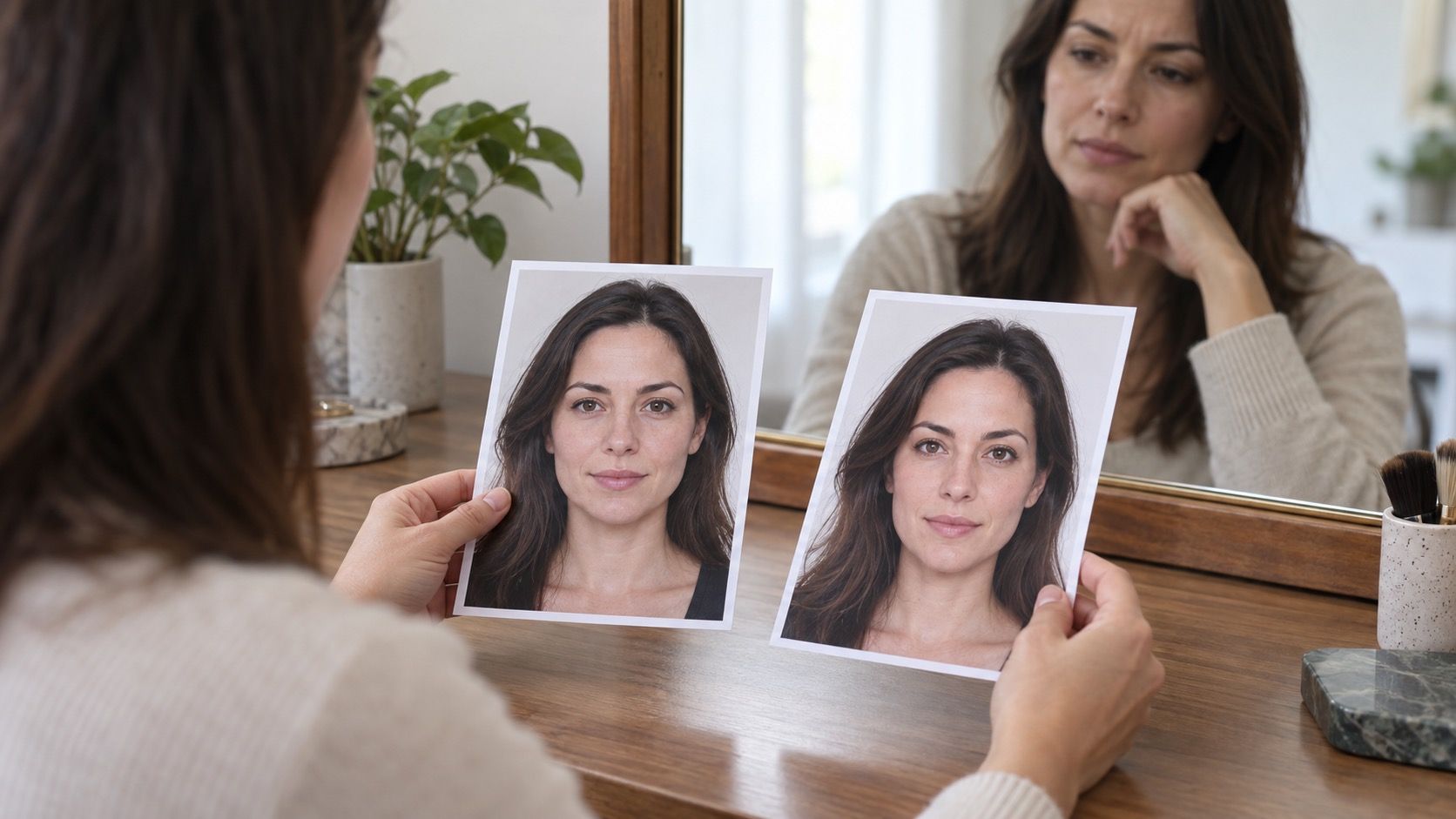
For a better reference, use the rear camera or ask someone to take a photo from several feet away at eye level. Face a window so light falls evenly across both sides, keep your expression neutral, and avoid tilting your head. Take a front view and a three-quarter view. The front view helps compare width; the three-quarter view reveals whether a shadow was created by bone structure, beard growth, or overhead lighting.
A mirror is useful too, but do not stand inches away from it. Step back until you can see the whole head and neck without moving your eyes from feature to feature. If the mirror image, a normal-distance photo, and your basic measurements broadly agree, you have enough information. If a close selfie is the outlier, blame the lens before blaming your face.
Keep the hairline visible when it affects the outline
Hairline is one of the easiest parts of face shape analysis to hide accidentally. A center part may expose more forehead than a deep side part; a fringe can shorten the apparent face length by an inch or more. For analysis, clip hair away from the temples and forehead, then take a second look in the style you normally wear. Both views are useful: one shows facial proportions, while the other shows the silhouette that matters for a haircut or glasses.
Do not assume a high or uneven hairline is a flaw that needs to be measured away. It is part of how the overall face reads, particularly in men's grooming. But it should not be confused with the top of a hairstyle. If your hairline has receded at the corners, use the central point for face length and note the temple shape separately. A sharp widow's peak can make the forehead look narrower without changing the cheekbone width beneath it.
Facial hair can hide the same information at the bottom. A full beard can make a tapered chin seem broad; a very sharp beard line can make a rounded jaw look square. Check the bare or short-stubble outline at least once before deciding that a beard shape proves your natural face category.
Account for asymmetry instead of trying to erase it
Nearly everyone has one eyebrow a little higher, one cheekbone that catches light first, or a jaw that sits fractionally differently from side to side. A face shape chart is drawn as a symmetrical outline, so it can be tempting to decide one side is “right” and the other is an error. In practice, the overall pattern matters more. Compare both sides and use the average impression rather than measuring only the more pronounced cheek or jaw corner.
Expression changes asymmetry as well. Clenching the jaw widens the lower face; a half-smile lifts one cheek and rotates the mouth. Relax the lips, let the teeth separate slightly, and take a few seconds before a photo. If you have an old injury, dental work, or a clear structural difference that concerns you, face shape advice is not a diagnostic tool; a dentist or clinician is the appropriate person for a health question.
For style decisions, asymmetry can guide practical adjustments. Glasses may sit differently on each side, a part may look better slightly off-center, and blush may need to be placed for equal visual weight rather than equal distance from the nose. This is not cheating the analysis; it is using it in a way that fits a real face.
Use style advice as a test, not proof of the category
A haircut that “should” suit an oval face can look poor because the fringe fights a cowlick. A pair of frames recommended for a round face can still overwhelm delicate features. That does not mean the original result was wrong. Style advice is built from broad visual tendencies, while hair texture, beard density, prescription lenses, skin contrast, and personal taste all change the outcome.
Test one variable at a time. If you think your face is long, try reducing extreme height at the crown before replacing your entire wardrobe of frames. If you think the jaw is broad, try a softer beard outline rather than concealing it under a long beard. Take photos in the same light after each change. A small record of what looks balanced is more trustworthy than a list of labels collected from different apps.
How to identify face shape accurately is therefore a process of cross-checking, not a quiz with one answer. Use a clear photo, stable landmarks, relaxed expression, and more than one observation. Once you can describe your proportions plainly, you have the information that matters—even if your closest category remains a blend of two names.