The best hairstyles for face shape are rarely found by matching your reflection to a single diagram. A haircut has to work with the way your hair grows, the amount of time you will give it in the morning, and the feature you want to emphasize or soften. Face shape is still a helpful map: it tells you where added width, length, texture, or a strong line may change the overall impression. Use it as a starting point, then let your real hair make the final decision.
Start with your hair texture and everyday routine
Before considering a face shape hairstyle guide, notice what your hair does without heat tools. Fine straight hair may fall flat at the crown even when a reference photo shows generous volume. Dense, coarse hair may create width exactly where a blunt cut ends. Wavy hair can become fuller or narrower depending on humidity, while curls change length as they dry. A cut that ignores these facts can look right for one salon photo and difficult for the next six weeks.
Decide what effect you actually want from the cut
Hair density matters separately from strand thickness. Fine but dense hair can make a soft bob look full; thick individual strands with low density may need a more careful layering pattern. Look at the crown and the hairline in daylight. If the scalp shows through easily, heavy internal thinning can remove more support than you want. If the ends constantly form a triangle, too many short layers may add bulk rather than movement.
Be honest about maintenance. A cut that needs a round brush, clips, and ten minutes of heat each day is not bad, but it is a different commitment from a wash-and-go shape. Bring photos of your hair on an ordinary day, not only its best day. They give a stylist more useful information than a perfect celebrity reference with a different density and texture.
People often ask for a haircut for my face shape when the underlying wish is more specific: soften a prominent jaw, make a long face look less vertical, show the cheekbones, make a broad forehead feel less exposed, or simply stop hair from falling in the eyes. Name that effect first. It stops the conversation from becoming a list of rules about oval, round, square, heart, diamond, or triangle faces.
Lines and volume create the effect. Width placed near the cheeks can make a long face appear shorter; height at the crown can add vertical lift to a rounder outline. A side sweep creates asymmetry, while a centered part often makes natural symmetry more visible. Soft texture blurs the edge of the silhouette. A sharp blunt line makes that edge deliberate. Neither is automatically flattering; the better choice is the one that supports the look you enjoy.
Think about what you do with your hair during the day. If you tuck it behind both ears, wear a headset, or put it in a ponytail for work, assess the cut in those positions. Face-framing layers that look good loose may vanish once tucked. A fringe may be appealing until it meets a humid commute or a sports routine. Small practical details are often the difference between a haircut you admire and one you keep.
Use length to adjust proportion, not to follow a rule
Short hair puts more attention on the forehead, cheekbones, and jaw because there is less surrounding shape. That can be clean and confident for any face shape when the top, sides, and hairline are considered together. A short crop with texture on top can add height; a softer side section can reduce the severity of a sharp temple. Very tight sides create a narrow upper silhouette, which may be useful or may feel too stark depending on the jaw.
Medium lengths are versatile because they allow volume to move. A bob ending at the jaw can echo that area; a bob ending just above or below it creates a different line. Collarbone hair can be shaped with layers around the cheeks, a bend at the chin, or fullness near the ends. The exact finishing point matters more than whether a cut is called a lob, shag, or layered bob.
Long hair offers a larger canvas but can pull the eye downward when it is very flat and one-length. Long layers, a slight wave, or lift around the crown keep the shape from becoming a vertical curtain. If your hair is fragile, do not chase movement with aggressive layers. A few well-placed face-framing pieces and a healthy blunt perimeter can look fuller and require less repair.
| Starting concern | Detail to test | Practical question |
|---|---|---|
| Face looks longer than desired | Width at the cheeks, curtain fringe, soft waves | Will the fringe suit your daily styling time? |
| Face looks rounder in photos | Crown lift, off-center part, length below the chin | Does the cut still work when air-dried? |
| Strong jaw feels dominant | Temple movement, soft layers, side sweep | Where will the ends sit when tucked behind ears? |
| Forehead feels broad | Wispy fringe or side fringe | Will it separate or become oily during the day? |
Choose fringe, layers, and parting as a set
A fringe changes the top third of the face, but its success depends on the rest of the cut. Curtain bangs open around the brows and blend into layers, which makes them forgiving as they grow. A side fringe can add movement to one temple and work well with a side part. Full straight bangs create a bolder horizontal line and need enough density to avoid splitting. They also need trimming more often than many people expect.
Layers should have a job. Near the cheekbones, they can bring attention upward. Below the chin, they can create a softer lower edge. Internal layers can remove bulk from very dense hair, but too much removal makes fine hair look stringy. Ask where the shortest layer will land when your hair is dry and how it will behave after a week of normal washing.
A middle part is not restricted to oval faces, and a side part is not a universal fix. Test both with your usual makeup, glasses, and clothing neckline. If one part looks good only when your hair has been professionally styled, it may not be the best everyday choice. The most sustainable part is usually the one that follows your natural growth pattern with only modest direction.
Translate face-shape ideas into a useful stylist consultation
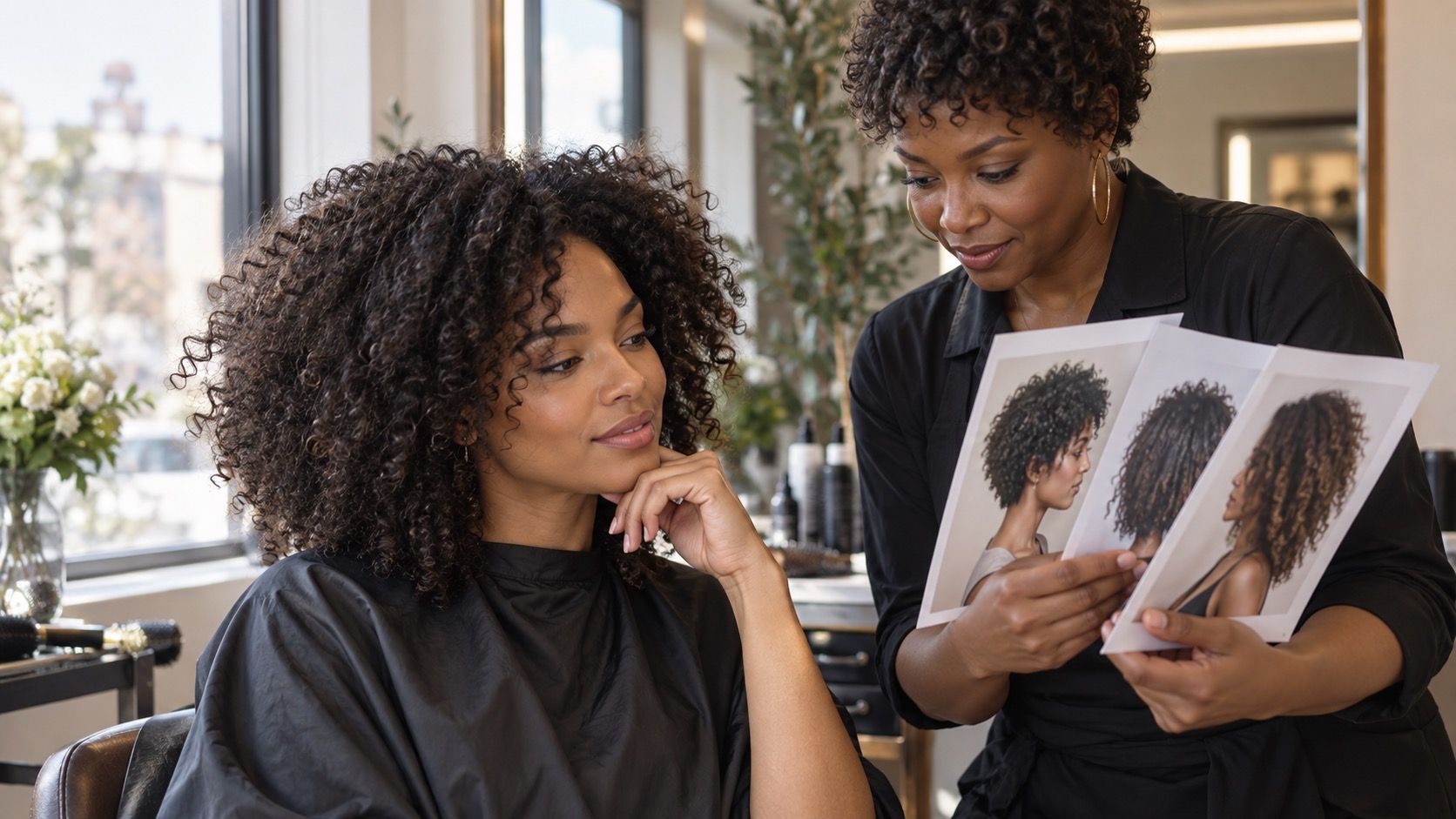
Bring two kinds of reference images: a few pictures of the mood you like and one or two honest pictures of your own hair at its usual texture. Then explain your routine. Say whether you diffuse curls, blow-dry twice a week, wear your hair up, need it away from your face, or avoid hot tools. A stylist can adapt a reference when they know the conditions it has to survive.
Use concrete language instead of asking for the universally best hairstyle. For example: “I want to keep my cheekbones visible but reduce bulk at the sides,” or “I want the crown to look less flat without a lot of styling.” If a dramatic change is tempting, ask for the smallest reversible version first: a longer curtain fringe, a few face-framing layers, or a shifted parting. You can always go shorter at the next appointment.
Clarify maintenance before the cape comes off. Ask how often the shape needs trimming, whether it needs product, which drying method creates the intended volume, and what will happen after the first wash. A good haircut supports your actual face shape and hair texture on a Tuesday morning, not only under salon lights.
Reassess after living with the cut for two weeks
Freshly cut hair behaves differently once the ends settle and your own washing routine takes over. Take a few casual photos in daylight after a week, including one with your normal glasses and one with hair tucked back. Notice where the volume lands and whether you keep correcting the same section. That observation is more helpful than judging the cut in the first hour.
If something feels off, identify the specific issue. A part may need moving a fraction, layers may need more connection, or the fringe may need to be styled in a different direction. Avoid changing everything at once. The goal is not to force your face into an ideal category; it is to build a haircut that looks intentional and remains manageable in your own hands.