An oval face shape is often described as balanced, which is useful only if you know what is being balanced. It does not mean every feature is small, symmetrical, or easy to style. It usually means the face is a little longer than it is wide, the cheekbone area is the broadest point or close to it, and the forehead and jaw taper gently away from that middle width. The best way to use that observation is as a starting point: compare proportions in a plain photo, then choose details that still feel like you.
Start with proportions, not a flattering label
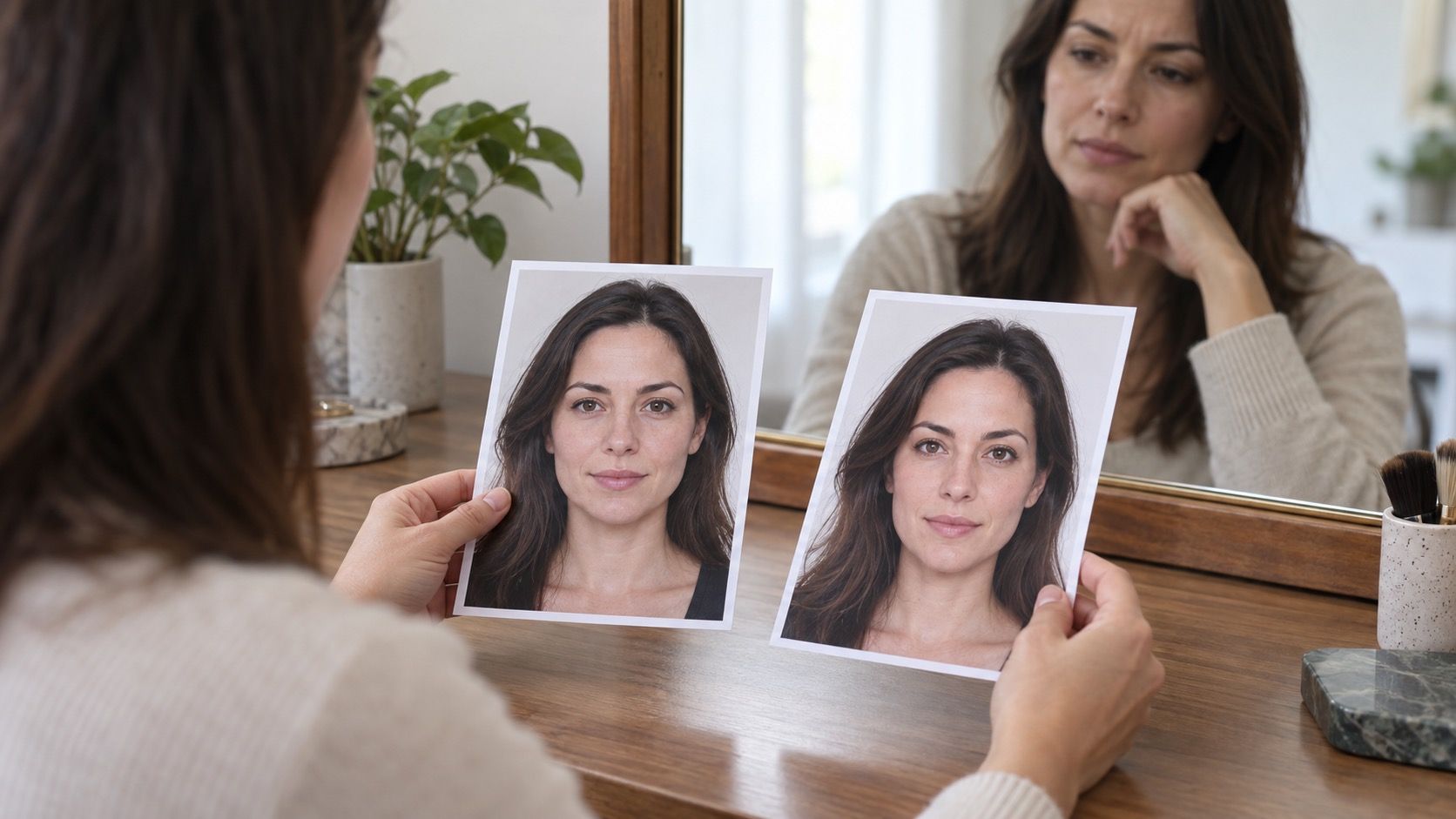
People sometimes call any face with a soft chin an oval face. That shortcut misses the main pattern. Look at a front-facing photo taken at eye level, with hair pulled away from the temples. An oval face generally has visible length from hairline to chin, but it is not dramatically long. The widest horizontal line often runs through the upper cheeks, while the forehead is slightly narrower and the jaw narrows again toward the chin.
Check the forehead, cheeks, jaw, and chin together
A mirror can be misleading because you tilt your head without noticing. A phone camera can be misleading too when it is close to your face. Step back, use the regular camera rather than a wide-angle selfie view, and take two or three shots in even window light. If the same relationship appears in all of them, it is worth treating as a real feature rather than a lucky angle.
The forehead of an oval face is often rounded at the corners instead of sharply square. It may be high, low, broad, or narrow; hairline height alone does not decide face shape. What matters is how the forehead relates to the cheeks and jaw. A gently curved hairline and a forehead that is modestly narrower than the cheekbone area fit the familiar oval outline, but neither is a requirement on its own.
At the lower half of the face, look for a jaw that eases inward rather than meeting the cheeks at a hard corner. The chin is commonly rounded or softly pointed. A pronounced chin, a fuller jaw, or strong cheekbones can all exist on an oval face. The useful question is whether those features create an overall taper. If your jaw is about as wide as your forehead and visibly angular at both corners, square or rectangle may be a better comparison.
| Area to compare | Often seen on an oval face | What to avoid overreading |
|---|---|---|
| Face length | Slightly longer than the widest part | A long forehead or a camera angle |
| Cheekbone area | Usually the broadest visual point | Temporary fullness or contour makeup |
| Jawline | Softly narrows toward the chin | One side appearing wider in a photo |
| Chin | Rounded or gently tapered | The idea that an oval chin must be tiny |
Separate oval from round, heart, and oblong faces
The most common mix-up is oval versus round. Both can have soft cheeks and a rounded chin, but a round face reads nearly as wide as it is long. An oval face keeps more vertical space between the brow, cheeks, and chin. If you draw an imaginary vertical line through the center, that line usually feels longer than the line across the cheekbones.
Heart-shaped faces can also narrow to a chin, yet their forehead or temple area tends to look distinctly wider than the jaw. With an oval face, the narrowing is gradual instead of top-heavy. Oblong faces share extra length but often have straighter side lines and less obvious width at the cheekbones. These are not courtroom categories. If two descriptions fit, use the one that helps you make a styling choice, then ignore it if the result looks unlike you.
Choose a haircut by the effect you want
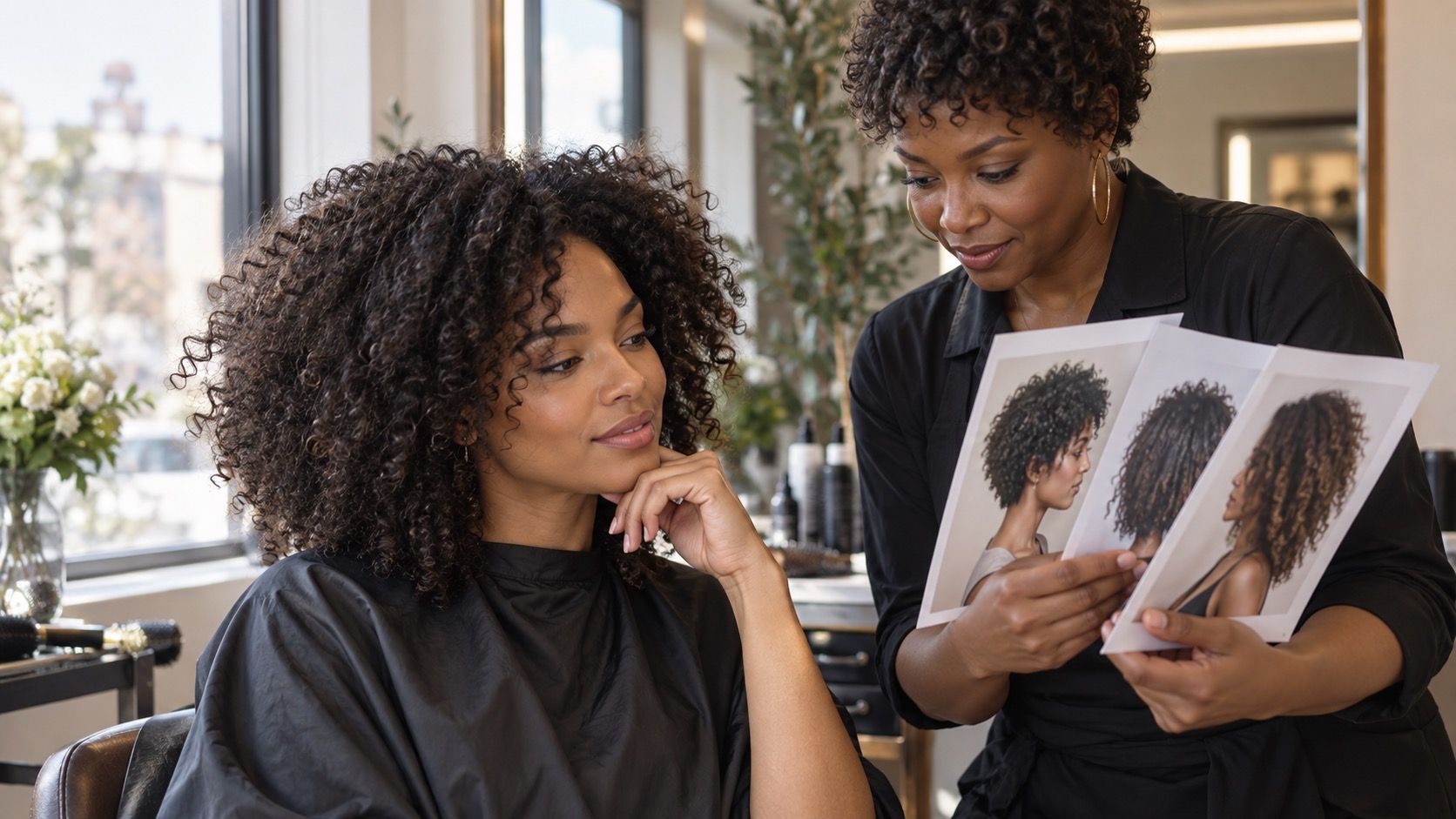
Because an oval face already has a fairly even outline, it can accommodate a wide range of cuts. That does not make every cut equally low-maintenance. A centered part can emphasize the natural vertical balance and works especially well when the hair has enough movement around the cheeks. A deep side part adds asymmetry and can be useful if you want the face to look less orderly or want to soften a very even hairline.
For shorter cuts, ask where the volume lands. Height at the crown can make the face appear longer; width near the ears can make it appear rounder. Neither effect is wrong. A blunt chin-length bob can look intentional on an oval face, while a longer bob with soft layers gives a more relaxed outline. If your hair is fine, do not copy a heavily layered reference without asking how it will behave after a wash day. The silhouette in the salon is only half the decision.
Fringe is another place where face-shape rules become too rigid. Curtain bangs can frame the cheekbones, a light textured fringe can shorten a high forehead visually, and a full straight fringe can create a strong horizontal line. Try to decide what you want from the fringe before asking whether it is “allowed” for an oval face: more softness, less forehead, a different parting, or simply a change in mood.
Use glasses as a proportion check in real light
Oval faces are often said to suit every frame, but frame scale still matters. A small narrow frame can disappear on a face with broad cheekbones, while an oversized square frame can cover the features you like most. Start by checking that the frame is no wider than the face at the temples, unless you deliberately want a fashion-forward oversized effect. Then look at where the top rim sits relative to the brows.
Rounded frames echo the soft jaw; angular frames add contrast. Both can work. The more practical distinction is bridge fit and lens height. A frame that slides down changes the apparent length of the nose and makes a balanced face look visually lower-heavy. Try glasses outside the optical-shop mirror if possible, near a window or in a quick phone photo. That is where reflective coatings, eyebrow placement, and actual proportions become easier to judge.
Makeup and brows can support, not redraw, your features
For everyday makeup, an oval face rarely needs aggressive contour to create structure. A small amount of bronzer placed softly beneath the cheekbone can add warmth without turning the face into a diagram. Blush placed around the center-to-upper cheek area often keeps the face lively. Pulling blush too far down can lengthen the lower face, which may be desirable for some looks but is not automatically more sculpted.
Brow shape is similar: a modest arch can follow the natural balance, while a very high arch adds drama and vertical emphasis. Keep the tail from dropping too low if you do not want the eye area to look tired. The useful test is simple: take one photo with your usual routine, then one with just one adjustment. Small changes are easier to evaluate than a new brow, contour, lip, and hairstyle all at once.
Let the category stay flexible
Knowing how to know if you have an oval face is not a test you pass once and never revisit. Weight changes, hairstyle, facial hair, aging, and even the width of your glasses can change the way proportions read. The underlying bone structure has not suddenly changed, but the styling problem in front of the mirror may have.
Use oval face characteristics as a compact description: slightly more length than width, a soft jaw, and a gradual taper around the forehead and chin. Then make choices from the evidence you can see. If a haircut, frame, or makeup placement gives you the effect you wanted, it has done more for you than a perfectly named face shape ever could.