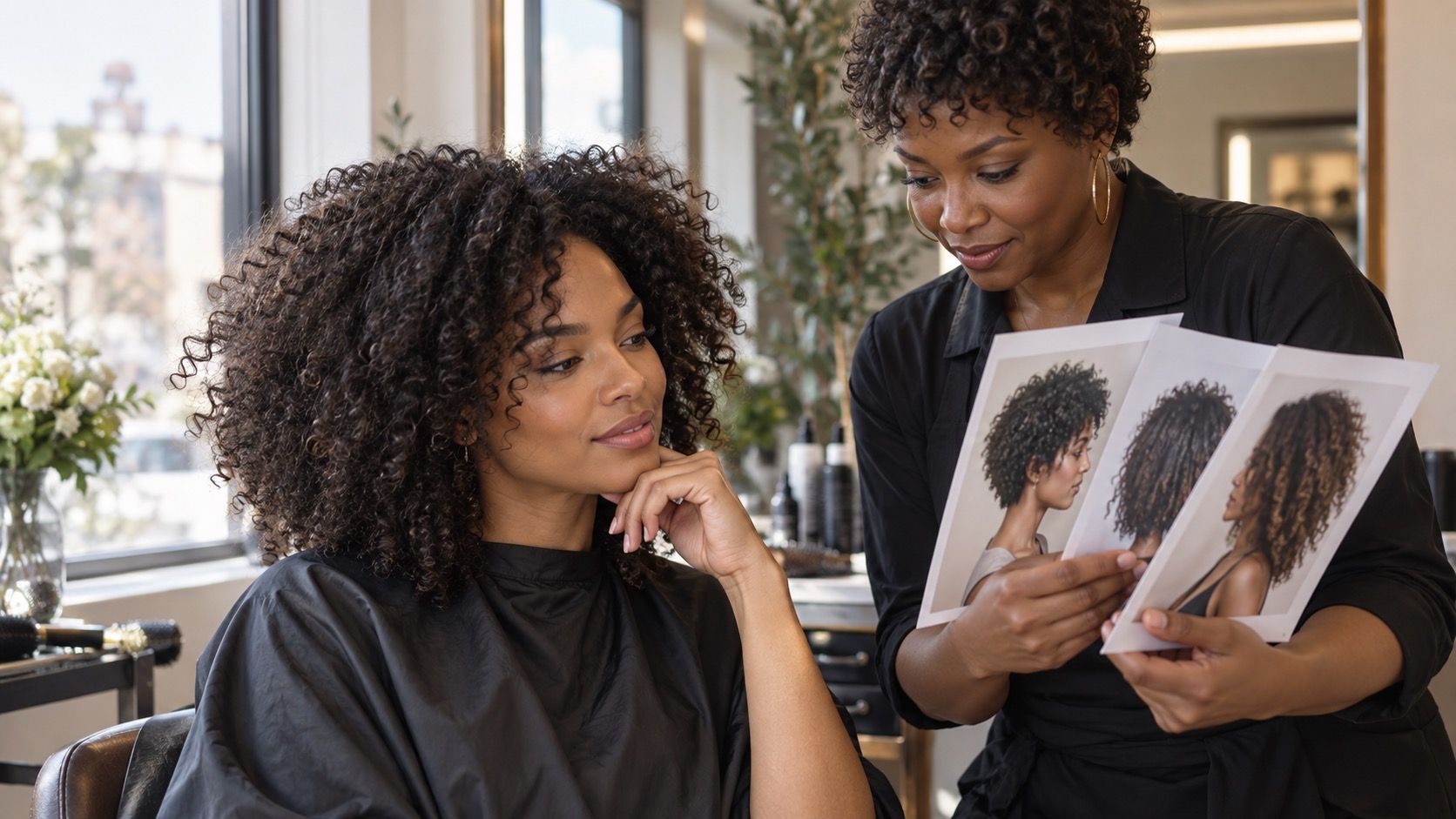
Oblong and rectangle face shapes are often grouped together because both look longer than they are wide. That is a sensible starting point, but it misses the detail that usually changes the styling advice: an oblong face has a softer, more oval flow through the jaw, while a rectangle face keeps clearer angles and more parallel-looking sides. You do not need exact geometry to use the distinction; a calm comparison of length, jaw corners, and side lines is enough.
Why the names are so often mixed up
Different guides use long face, oblong face, and rectangular face as if they mean the same thing. In casual conversation, they sometimes do. For practical styling, though, oblong usually describes a lengthened face with rounded transitions, while rectangle adds angularity: a straighter forehead-to-jaw line, a more defined jawline, or corners that remain visible instead of melting into a curve.
Look at length first, then at the corners
Both types can have a tall forehead, high cheekbones, or a narrow chin. Those details do not settle the question on their own. What you are comparing is the side outline. Does the face taper and curve from cheek to jaw, or do the sides hold a similar width for longer before turning at the jaw? The answer can shift how a fringe, beard, or frame reads.
It is also normal to be between categories. A person may have the length of an oblong face and the jawline of a rectangle. In that case, use the features that are most visible to choose a style, rather than treating a single label as a permanent verdict.
Start with a straight-on photo taken at eye level. Measure from the center of the hairline to the bottom of the chin, then compare that with the widest span across the cheekbones. On both an oblong face and a rectangle face shape, the vertical measurement will generally be noticeably greater. A tape measure is optional; comparing proportional relationships is more useful than chasing a universal number.
Next, study the jaw. An oblong face tends to have a longer silhouette with a rounded or gently tapered jaw. A rectangle face can still narrow slightly at the chin, but its jaw corners and lower sides usually look more structured. The forehead may also appear flatter across, creating a more architectural outline from top to bottom.
Do this with your hair pulled back and your teeth unclenched. A smile lifts the cheeks and can make an oblong face look rounder; a tilted head can make the jaw appear sharper. Compare two relaxed photos rather than deciding from a single close-up image.
Use the side outline as the deciding check
Imagine a line running down each side of your face. On an oblong face, that line usually bends gradually: there is some cheek width, then a mild inward movement toward a rounded jaw. On a rectangle face, the sides often look more parallel from temple to jaw, with a clearer change of direction at the jaw corners. The face may look longer and more defined even when the measurements are similar.
Cheek width can confuse this check. Prominent cheekbones do not automatically make the face diamond-shaped if the forehead and jaw are also fairly substantial. Likewise, a square jaw does not automatically mean square if the face length is the dominant feature. Keep the full outline in view rather than naming a shape from one dramatic feature.
| What to compare | Oblong face | Rectangle face |
|---|---|---|
| Overall proportion | Longer than wide, with a gentle flow | Longer than wide, often more structured |
| Jawline | Rounded, soft, or lightly tapered | More angular with clearer corners |
| Side outline | Gradual inward curve | More parallel-looking from temples to jaw |
| Best styling priority | Add width and break up length | Soften angles while managing length |
Measure proportions without making the process fussy
If the mirror still leaves you unsure, take four simple measurements: face length from hairline to chin; forehead width from temple to temple; cheekbone width across the outer cheekbones; and jaw width across the jaw corners. Record them once with a soft tape, then look at the result as a pattern. Long faces show a clear vertical emphasis; rectangle faces usually retain more similar width through the forehead and jaw than oblong faces do.
Measurements cannot capture every visual cue. Hairline height, facial fullness, and camera distance all influence the apparent ratio. Treat the numbers as a tie-breaker, especially if your face looks different in photos than it does in the mirror. A measured result that contradicts every natural image is a reason to recheck the photo conditions, not to force the number.
For grooming or makeup, you only need enough certainty to make a sensible experiment. If the jaw feels angular, test a softer treatment around it. If length is what stands out first, use visual width and horizontal detail. The response in the mirror is more valuable than a perfect category label.
Choose hair shape to manage length and texture
Both groups often benefit from hairstyles that interrupt uninterrupted vertical length. A fringe, curtain bangs, side-swept fringe, or layers that begin around the cheekbones can create a horizontal pause. The right version depends on texture: fine hair may need a lighter fringe and a little side volume, while thick hair may need internal layering so the sides do not become a solid triangle.
For an oblong face, soft waves and medium-width around the cheeks or jaw often work naturally because they add breadth without fighting the face's rounded transitions. Long, pin-straight hair with no layers can make the length more noticeable, particularly when parted precisely in the center. That can still be an intentional look, but it is worth knowing what it emphasizes.
For a rectangle face, similar width can be helpful, but softer edges matter more. A textured bob, a longer fringe, or waves around the jaw can ease the strong corners. Extremely blunt cuts that end at the jaw may underline its angularity; shifting the endpoint just above or below it, or adding a slight bend, often changes the effect.
Pick frames and grooming details for the feature you want to soften
Glasses can change the visual read faster than a haircut because they introduce a strong horizontal line. Oblong faces often suit frames with noticeable lens height or a little width, which can reduce the sense of vertical stretch. Avoid choosing a very narrow, shallow frame solely because it is trendy; it can make a long face look longer by leaving more visible space above and below the lenses.
Rectangle faces can use the same width, while rounded corners, oval frames, and softer brow lines may balance the jawline. Very boxy frames can be attractive if you enjoy a graphic look, yet they often repeat the face's angles rather than contrast them. Try one angular pair and one rounded pair in the same size; the comparison is usually clearer than any online rule.
For facial hair, a rectangle face may look more relaxed with softened edges at the jaw rather than a sharply squared beard outline. An oblong face often benefits from controlled width at the sides instead of extra length at the chin. These are small adjustments, not corrections. The best choice is the one that feels proportionate in motion, not only in a frozen front-facing photo.