A good haircut and beard do not require a perfect label for your face. They require noticing proportions: where your face is widest, how long it looks from hairline to chin, how much jaw is visible, and what your own hair will actually do after two weeks. A male face shape guide is useful when it helps you explain a preference to a barber, not when it turns grooming into a set of rules.
Identify proportions without overthinking the label
Stand in front of a mirror with your hair pushed back and keep your head level. Compare four areas: forehead width, cheekbone width, jaw width, and overall length. A face that is longest from hairline to chin may read as oblong; one that is nearly as wide as it is long may read as round or square depending on the jaw. The exact category is less important than the proportions you notice twice, in both a mirror and a normal photo.
Recognize the patterns that matter at the barber chair
Do not measure with a tape as if you were making a medical chart. A soft tape can be useful for comparison, but hairline shape, facial hair, and uneven features make strict ratios misleading. Look at the silhouette first. A rounded jaw and full cheeks create a different styling problem from a straight jaw with the same cheekbone measurement.
Take one picture from several feet away with the rear camera, in daylight, and without tilting your chin. Close selfies exaggerate the nose and center of the face, while a low camera angle makes the jaw look wider. If you wear glasses most days, keep them on for one of the photos: the frame is part of the face people see and it changes where visual width sits.
Men's face shapes are usually described as oval, round, square, rectangular or oblong, heart, diamond, and triangle. An oval face has relatively even proportions with a gently narrower jaw. A square face has a broad, defined jaw and forehead. A round face has softer angles and similar width and length. These descriptions are useful only as shorthand; plenty of faces sit between two categories.
A rectangular face is longer than it is wide, often with a fairly straight jaw. A heart-shaped face tends to be wider at the forehead and cheekbones and narrower at the chin. Diamond faces are widest at the cheekbones with a narrower forehead and jaw, while triangle faces can look wider through the jaw. The practical point is to decide whether your haircut should add height, width, softness, or structure—not to win an argument about the name.
Hair density can override the usual advice. A man with a round face and very thick, upright hair may already get plenty of height. Someone with an oval face and a receding hairline may not want a high, disconnected style even though it suits the outline in theory. Cowlicks at the crown, a widow's peak, and temples that grow unevenly should be discussed before the clipper comes out.
Choose a haircut silhouette before asking for a fade
The silhouette is what remains visible after the product wears off. For a round face, some controlled height at the top and tighter—but not necessarily skin-faded—sides can create a more vertical impression. A textured quiff, short pompadour, or side-swept crop works when the top has enough density. Avoid building width at the temples with a bulky side part unless that is the look you actively want.
For a long or rectangular face, the reverse often helps: keep moderate length at the sides and avoid excessive height at the crown. A low taper, classic scissor cut, or fringe with texture can break up a tall silhouette. A very high fade combined with a tall pompadour can make the face look longer, even if both features are individually fashionable.
A square face can carry short sides and clean lines well, but an ultra-sharp boxed hairline plus a heavy square beard can become severe. Texture at the top or a softer transition in the sideburn area gives the cut some movement. For an oval face, most shapes are workable; the main danger is choosing a style that fights your hair growth pattern. For heart or diamond shapes, avoid taking all volume away from the temples if that leaves the upper face looking dramatically wider than the chin.
| Starting proportion | Haircut direction to test | Common overcorrection |
|---|---|---|
| Round or soft through the cheeks | Moderate height, controlled side bulk | Very high, rigid volume with bare sides |
| Long or rectangular | Some side presence, modest crown height | High fade plus tall pompadour |
| Broad jaw and forehead | Texture and a less severe outline | Boxing every edge into a hard square |
| Narrow chin or wide cheekbones | Balanced temples and a natural fringe | Removing all side volume |
Use beard shape to balance, not disguise, the jawline
A beard changes the apparent lower third of the face more quickly than a haircut, which is why it can either help or make an imbalance louder. On a round face, keeping the sides of the beard tidy and leaving a little more length at the chin can add definition. The difference should be gradual; a long pointed goatee attached to very short cheeks can look pasted on rather than deliberate.
On a long face, avoid adding most of the beard length below the chin. Letting the sides stay a touch fuller can add perceived width, while a short boxed beard or close stubble keeps the lower third from stretching further. Men with a square jaw may prefer a rounded lower beard edge to soften hard corners. The goal is not to hide a jawline; a little shadow at the edge can make it look cleaner than a beard cut into a perfect rectangle.
Growth pattern sets the limit. Sparse cheek growth does not need to be forced into a high beard line, and a patch under the lower lip does not require a complicated workaround. A shorter style maintained every few days usually looks more intentional than a longer shape that depends on density you do not have. Use beard length after you have chosen the neckline: two fingers above the Adam's apple is a reasonable starting point, then adjust for your neck and jaw rather than shaving a straight line too high.
Fade height, sideburns, and glasses change the balance
A fade is not just a level on a clipper guard. Its height removes or preserves visual width. A high fade exposes the temples and can elongate the face; a low fade leaves more shadow around the sides and often feels more balanced for a longer face. A mid fade is flexible, but the blend should follow the head shape rather than rise sharply behind the ear for no reason.
Sideburns create a bridge between haircut and beard. If they end abruptly above a full beard, the face can look split into separate zones. If they are left too bulky beside a close fade, they can add width exactly where you do not want it. Ask for a soft transition, then check it after a week of growth. A good cut should still make sense when the sides are no longer freshly faded.
Glasses deserve the same consideration. Wide, heavy frames add width at the eyes, while narrow rectangular frames emphasize length. There is no rule that a round face cannot wear round frames, but doubling the same curve or angle in every feature can feel busy. Bring the pair you actually wear to the appointment; it is easier for a barber to judge the whole silhouette with them on.
Give your barber usable information, then leave room for judgment
Instead of requesting a men's haircut for face shape from a chart, describe the result you want: less width at the sides, no extra height, a beard that does not make the chin look longer, or something that grows out quietly. Mention your usual styling time and whether you use a dryer. A haircut that needs ten minutes of product every morning is not practical if you usually leave home with damp hair.
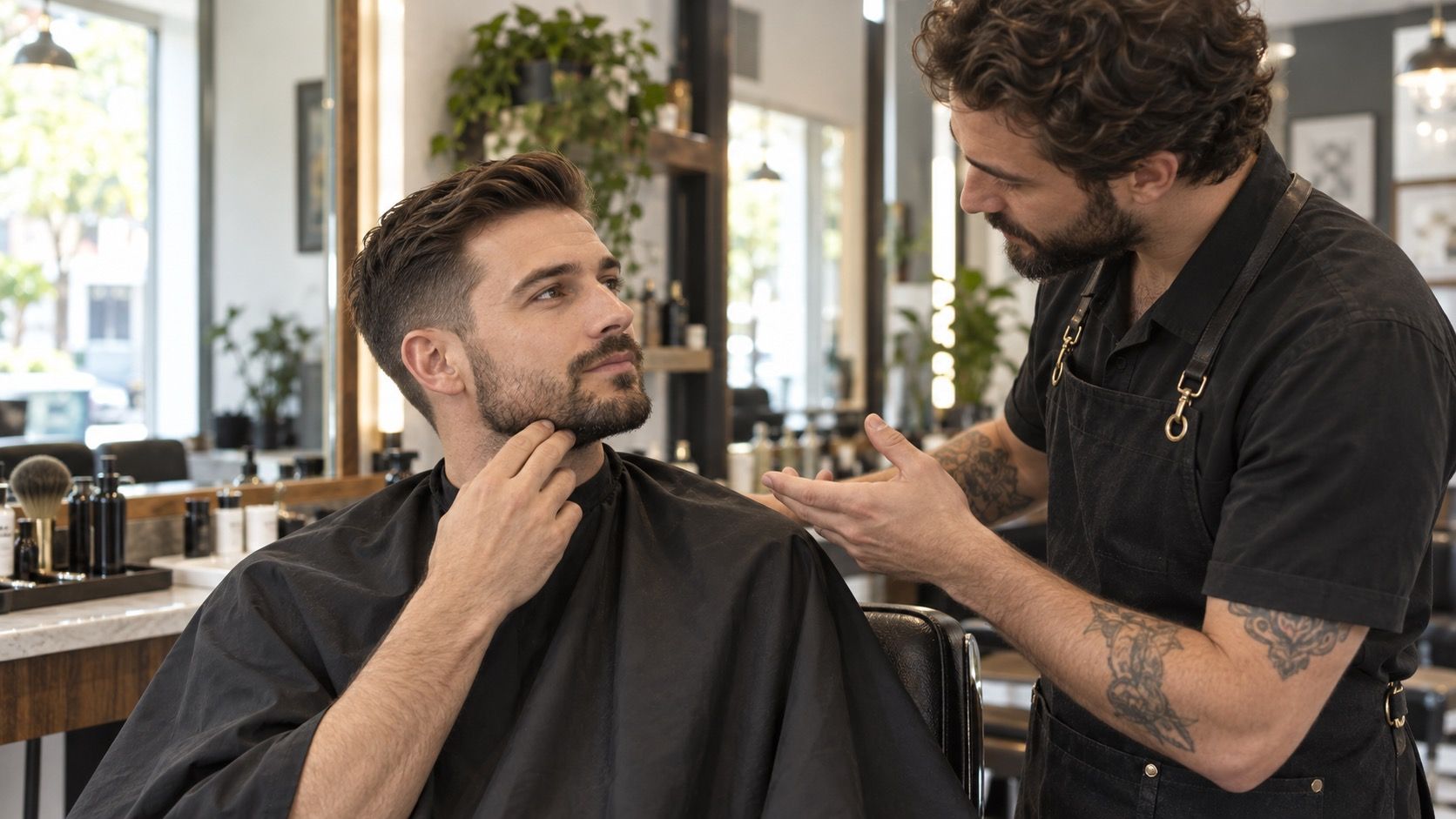
Bring two or three photos that show a similar hair texture and density, not just a celebrity with different hair and a different head shape. Point out what you like in each: the fringe, the side length, the beard outline, or the way it looks after it has grown out. Let the barber explain where the idea needs adjusting for your hairline or cowlick. That conversation is more valuable than insisting that one face-shape label has a single correct cut.
At the end, ask what to do between appointments. Learn where to keep the cheek line, how much product to use, and when the neckline will begin to look untidy. Grooming works best as a small routine: a cut with an understandable silhouette, a beard shape you can maintain, and choices that still look like you.