You can find your face shape from a photo, provided the photo is built for proportion rather than drama. A close selfie, a tilted chin, and overhead lighting can turn a soft jaw into a point or make the center of the face look much wider than it is. One plain, front-facing picture taken carefully is more useful than twenty flattering portraits.
Choose a photo that shows proportion instead of personality
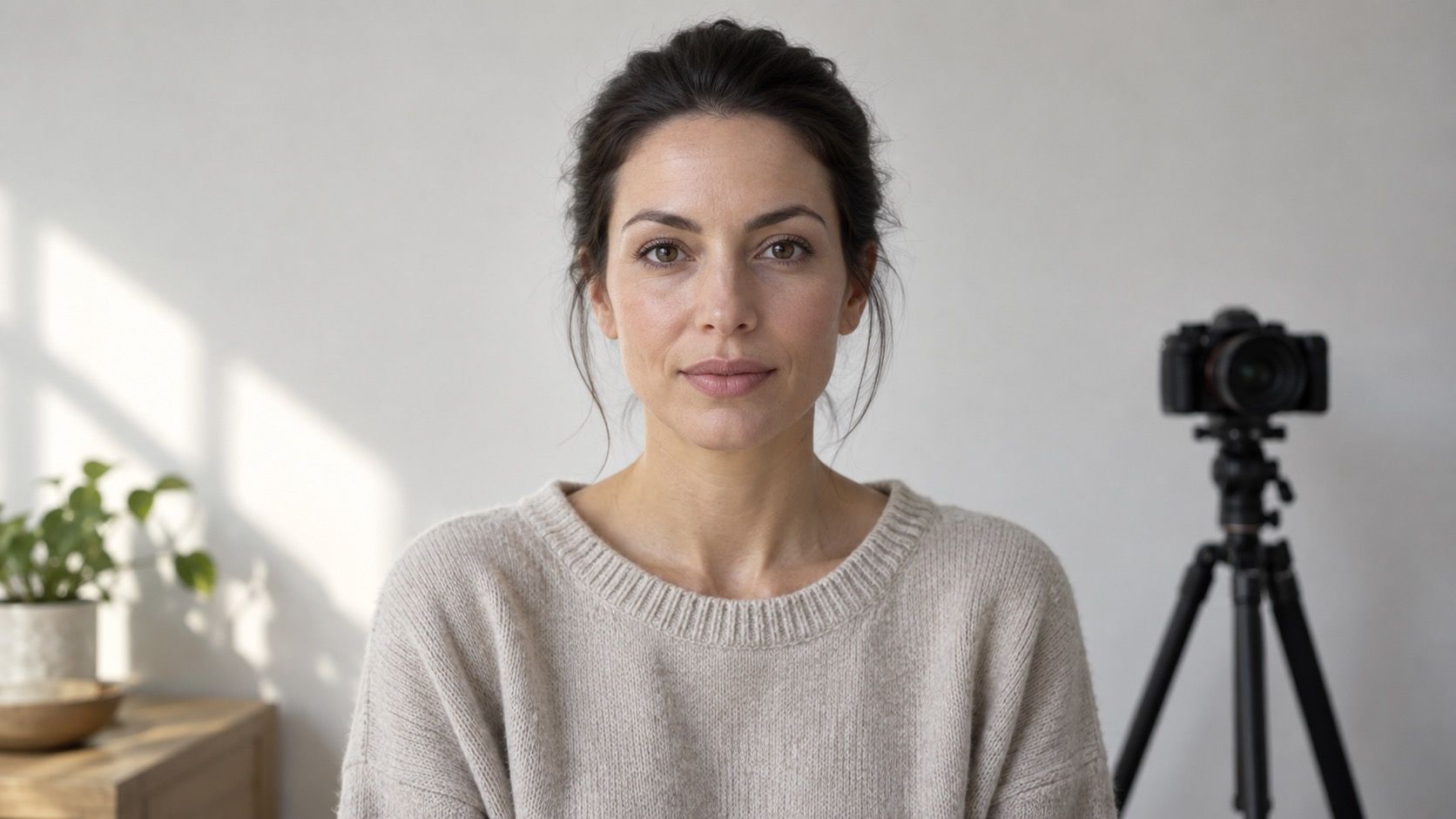
Start with a front-facing image where both sides of the face are visible. Your eyes should be level with the camera, the mouth relaxed, and the head neither turned nor tipped. A passport-style pose may feel unglamorous, but it makes the forehead, cheekbones, and jawline easier to compare. Save expressive photos for another purpose; smiling broadly lifts the cheeks and can conceal the normal lower-face contour.
Set camera distance and light before you trust the picture
Keep hair away from the temples and jaw if possible. Loose curls, a wide fringe, or hair resting on one cheek can be part of your style, but they are not part of the facial outline you are trying to read. If you have a widow’s peak or a naturally uneven hairline, leave it visible. The objective is not to create a perfectly geometric shape but to see the shape you actually have.
Use a recent photo. Weight changes, beard growth, a new haircut, and even a different pair of glasses can alter the visible balance. For a face shape photo test, a bare, current image gives you a dependable base; after that, you can judge how your everyday styling changes the impression.
Place the phone or camera several feet from your face and use a timer, a stand, or help from another person. The rear camera is often a better choice than the front camera because it usually gives a less exaggerated result. When a wide phone lens sits inches from the nose, the center of the face appears larger and the sides recede. That is lens distortion, not evidence of your face shape.
Put the camera roughly at eye level. A high angle shortens the lower face and makes the forehead dominate; a low angle enlarges the jaw and nostrils. Stand facing a window with indirect daylight, or use two soft lights placed evenly in front of you. Harsh sunlight from one side can create a false shadow beneath one cheekbone and make the face look asymmetrical or much more angular.
| Photo setup | What it changes | Better choice |
|---|---|---|
| Close selfie | Enlarges central features | Camera several feet away |
| Camera above eye level | Shortens the lower face | Lens level with the eyes |
| Side window light | Deepens one side of the jaw | Soft, even front light |
| Portrait mode blur | Can soften hair and contour edges | Standard photo mode |
Do not rely on a single phone if the result seems strange. Take one image with the rear camera and another at a slightly greater distance, then compare the broad outline. A reliable setup will preserve the same relationship between forehead, cheekbones, and jaw even if the photos are not identical.
Read the outline in a deliberate order
When you determine face shape from a picture, begin at the widest point rather than the chin. Is the forehead widest, are the cheekbones widest, or do forehead, cheeks, and jaw stay close? This first observation narrows the possibilities without asking the photo to be more precise than it can be.
Next follow the sides downward. A heart-shaped outline often begins broad at the forehead and narrows toward a more pointed chin. A diamond shape tends to show prominent cheekbones with a narrower forehead and jaw. An oval outline is longer than it is wide, with a smooth reduction toward the chin. Round and square faces can share similar length and width, but a round face has a softer curve while a square face keeps more direct width through the jaw.
Look at the photo small enough to see the whole head at once. Zooming in too far turns ordinary skin texture, a stray hair, or a slight shadow into a major landmark. If helpful, lightly trace the silhouette on a copy of the image, following the outer edge from hairline to chin. Use a simple line; the goal is to compare large proportions, not to map every contour.
Check face length against width with a second view
Estimate face length from the central hairline to the bottom of the chin, then compare it with the broadest horizontal point, usually the cheekbones. You do not need software for a useful first pass. A longer vertical span supports oval, oblong, or rectangular tendencies; similar height and width support round or square tendencies. The jawline and forehead decide which of those close neighbors makes sense.
For a more careful check, place a ruler beside the screen or use a simple editing grid without stretching the image. Measure pixels only as a ratio: the actual unit does not matter. Compare the forehead, cheekbone, and jaw spans in the same photo. If the differences are tiny, do not pretend they establish a sharp category. A mixed result is common and often the best description.
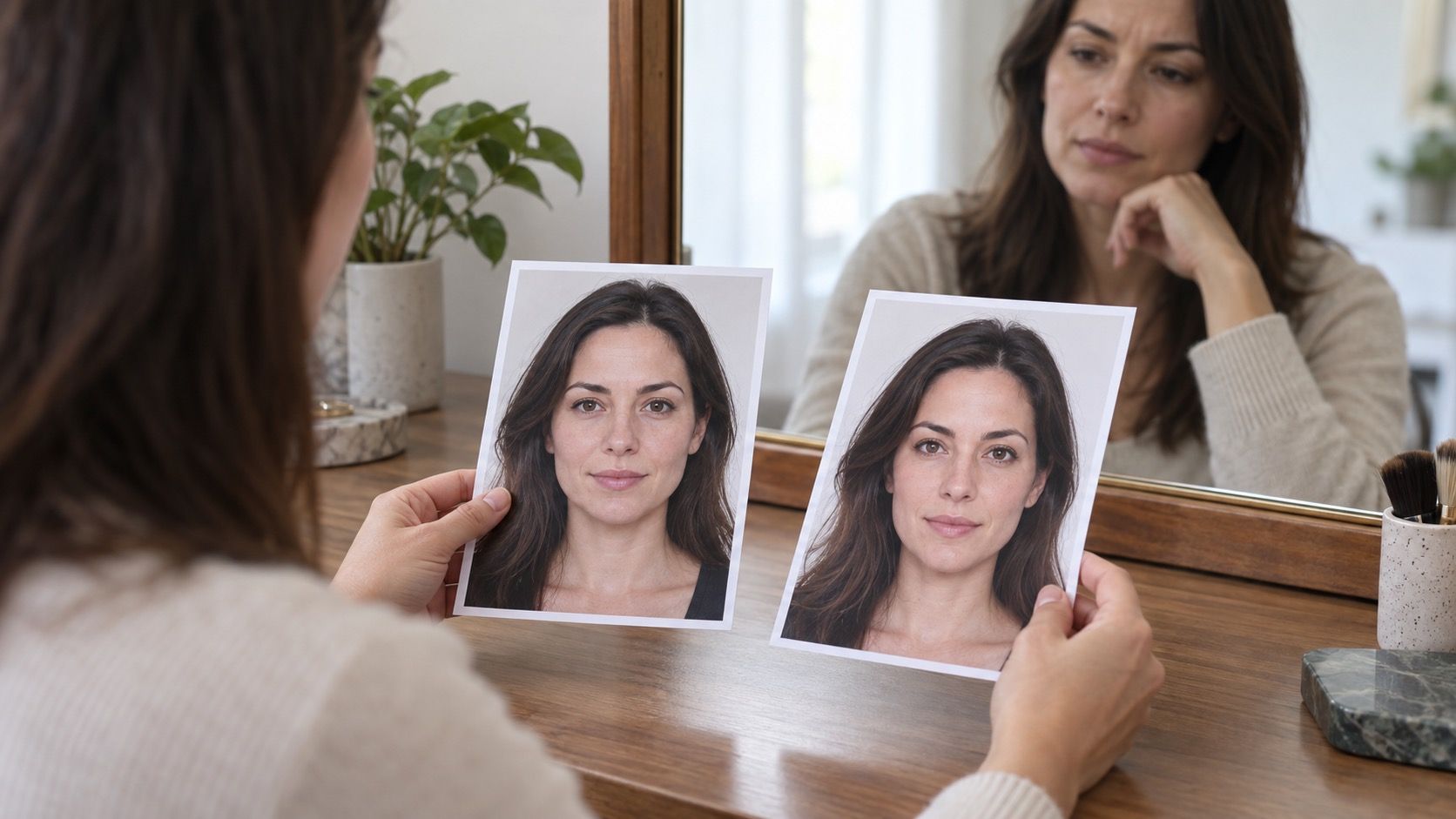
Cross-check with a mirror or a second image made in the same neutral pose. If the photo says your cheeks are widest but the mirror shows a broad jaw, inspect the angle and lens before choosing a label. The right answer should be repeatable across ordinary views, not dependent on one particularly good or bad picture.
Why selfies and edited photos can send you in the wrong direction
Selfies are convenient, but the lens is usually close enough to alter proportion. A small change in distance can make the nose and middle face feel larger, while the ears, temples, and jaw fall away. That may make a balanced oval face look narrow at the sides or make a heart-shaped face appear more triangular than it does in person.
Filters add another layer of uncertainty. Beauty smoothing can erase the subtle transition at the jaw, face-slimming tools may narrow the cheeks, and portrait mode can melt the boundary between hair and skin. Even a flattering mirror photo can be misleading if the mirror is curved or you are leaning in toward it.
Use a face shape from photo as a practical sketch, then test the conclusion against reality. Try frames or hairstyles that suit the proportions you observed, take a normal-distance picture, and see whether the balance feels right. That approach is more valuable than treating a face shape photo test as a fixed identity. Your features do not need to match a diagram to give you useful styling information.